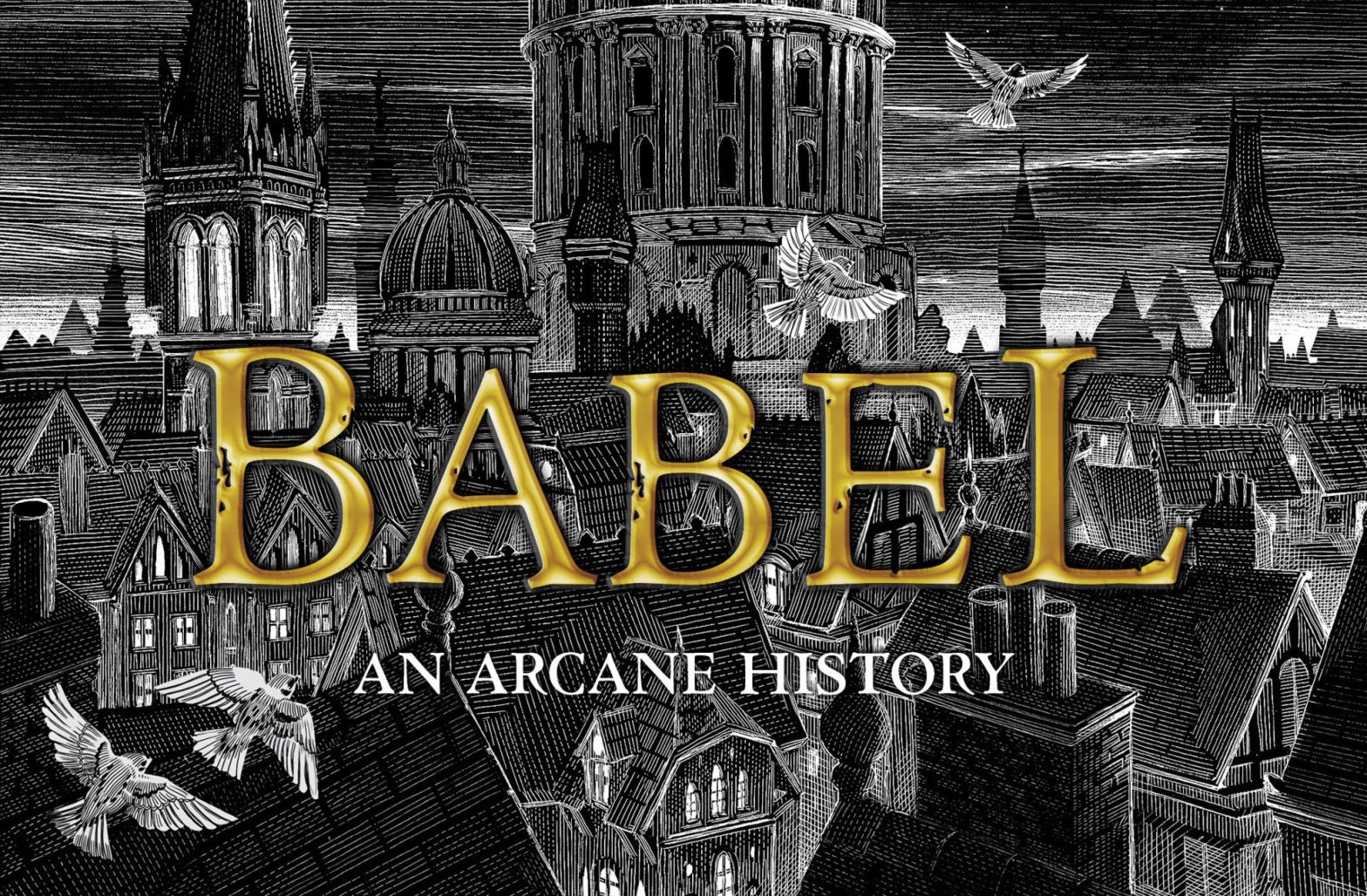

So I will be completely honest. Of late, I have avoided buying pretty much any new books in the sci fi and fantasy genres for the simple reason that they have become unsubtle social justice commentaries with the allegorical subtlety of a brick falling down the stairs. The current trend towards revisionist views and applying 21st century mindsets to 19th and early 20th century problems, just doesn’t do it for me. My views on this also meant that alt history was also out. That being said Babel was a fantastic looking book, and whilst I don’t believe in judging a book by its cover, I do think that something which looks so strikingly different is always worth consideration. I have also read some of this author’s previous work and enjoyed it. So as a result, I was prepared to step away from my prejudices and give this one, a punt.
So Babel is set in an alternate version of 19th century England. It is set round the time of the rise of the British Empire to its zenith of power, against the backdrop of the Industrial Revolution. The world is driven by silver, and the use of match pair words to power it which I think is a really interesting touch. It provides a new spin on a world which is familiar and is just different enough to allow for world building.
We are introduced to a Cantonese orphan Robin Swift, a child of mixed heritage who is rescued by a academic English benefactor and brought to England to learn the details of linguistic translation. The drive of his benefactor in doing this is to involve Robin in the production of silver bars that will be sold or used commercially and generate money for the British. Over the course of the story, Robin finds that the world that he’s been brought into is not as benign and generous as he initially thought it to be and eventually he rebels against the British Empire. The consequences of that rebellion are not fully explored and the book ends with a perhaps predictable outcome. The ending was rather unfulfilling but does potentially set up a sequel. Now that’s a really high level synopsis of what is a voluminous and deep novel. I don’t want to give away too much information about it and don’t want to set up spoilers for people especially with this being a relatively new book. What I will say is that whilst this book is technically brilliant, I found it a complete emotional vacuum. Indeed, I would say I did not enjoy reading this book. I didn’t dislike reading it. But equally, it did nothing for me. It did not stir any real emotion in it. I felt no real deep connection to any of the characters, the world or the story. So much so that when I’d finished the book, there wasn’t a sense of disappointment that had finished it hoped for a sequel, or indeed anything at all. It was just a case of “oh, I’m done. Okay.”
So, having thought about this for a while since I finished reading it, about three weeks ago, I’ve come to some conclusions why I feel the way I do about it. The first issue I have with the book is the pacing or rather the lack of it. There are large sections of the book that delve deeply into the etymology of words. This, whilst fascinating and of interest to an academic, or indeed anybody like me with an English literature language background, absolutely kills the pacing stone dead. Yes, it gives depth and a sense of permanence to the world, but it’s used so often, that you get the sense that the author is showing off the depths of research, rather than actually creating a narrative that’s accessible to all people. Indeed, I suspect the sections would lose quite a large proportion of the readers. It’s just not enjoyable to sit there listening to how words have adapted and changed to become the words we know now from what they were originally. Narratively, it’s slow and whilst interesting for me personally; for many it will be a dead end. Indeed, it doesn’t actually add anything to the plot directly. Now, that’s fine. You can have non essential plot elements in a story. But it’s used so often it began to feel like padding.
The second issue I have with the book is it stirred absolutely no emotional engagement with me. It never gripped me and refused to let me put it down. Characters are explained well, in that you get a sense of their motivations. You obviously learn their appearance and their backstory, but I just felt no emotional connection to them. Likewise, the world is the same in that it exists but it isn’t lived in. What I mean by that is a little hard to explain. This story is set in university at the turn of the 19th century there are racial stereotypes, gender stereotypes and class stereotypes all of which have been captured brilliantly. There is absolutely no doubt that the author has a solid knowledge of the source material that has been used as the basis for this world. The problem is it doesn’t feel like a world that is lived in. Everything is set in a few small areas, and you get no real sense of the wider world around them. As a result, it becomes very difficult to relate to any of the characters. I have thought about this at length and I felt no connection at all to the protagonist Robin and indeed didn’t throughout the book. In fact, if you were to ask me now, three weeks later to describe the character, there would be very little I could actually say over the kind of high points I’ve emphasised above. Contrast that with some other works are fantasy and fiction, which I’ve read, for example, Lord of the Rings, Wheel of Time, or the Ascension Cycle, which I’ve written about before. Those books have a world that feels lived in and alive, characters that you relate to you feel their pain, you want them to succeed. You don’t want them to open the door that you know, our sense will be bad. In Babel, I just didn’t care.
I don’t want to be completely down on what is, as I say, technically a brilliant book. There are no narrative holes of any particular concern here. The book is exceedingly well written from a technical perspective and there has clearly been a monumental amount of research carried out on it. The author also does a better than average job of balancing the criticism of the choices of the British Empire mainly by pointing out that other nations were doing the same thing. There is also more highlighting that some good things did indeed come about from colonialism than I excpected. Given the current climate of course, it is to be expected that the criticisms outweigh the praise and that’s perhaps understandable but there was at least a sense of balance here. There is even a bit of a discussion about whether the motives behind poisitive changes such at the end of slavery were indeed benign or not driven by vested interests. It was a refreshing surprise to see this and was not what I expected; though it does have to be said that that is kept fairly perfunctory, and I would have liked to have seen this explored further.
I don’t know if Babel will get a sequel. What I do know is I wouldn’t buy it. As beautiful looking as Babel is, as technically well written as it is, it is just a void for me. Indeed, I actually put the book down for over a week just to see, would I be pulled back into it? And at no point did I think “I really need to go back and finish reading that book”. In the end, I finished it simply because I’d bought it. The only reason I’ve not gotten rid of it is due to it being a signed copy.
So to sum Babel up, it’s a technical brilliant, wide and expansive story with a deep underpinning of real world understanding and historical learning. However, for me, it was emotionally void and the pacing was often so torturous that I found myself wondering, was this a story or an actual academic paper. I’m not sure who I could recommend this book to if I am honest. If you want something that is different and beautiful to look at, then give it a go. But if you’re just looking for some casual escapism, or a slightly darker academic fantasy based book, I’d give this one a miss.
 Roll 3's to hit