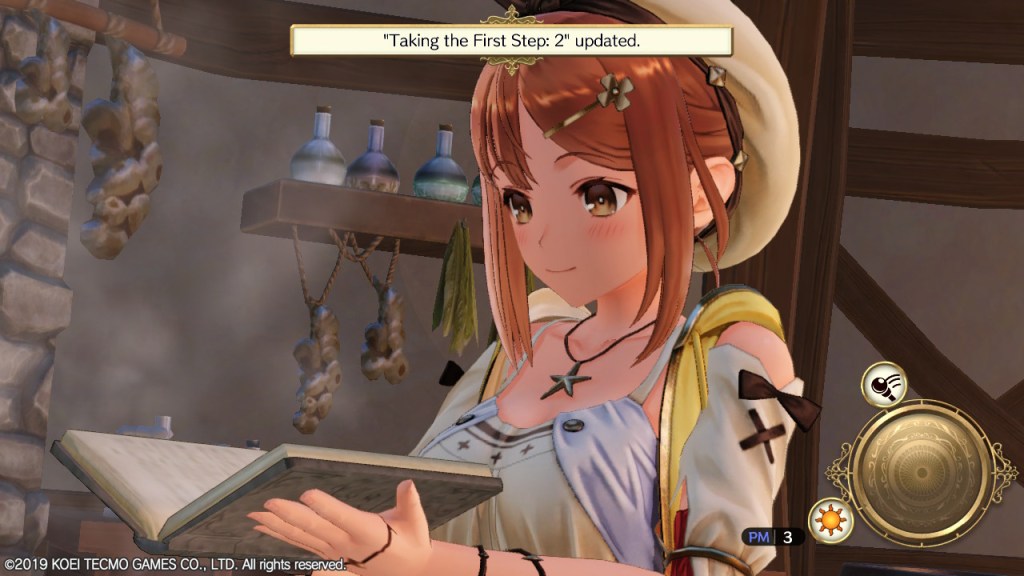
As I have said before I am not a good gamer. I do not have the commitment to spending ages maxing out a tech tree or learning all the deep and intricate mechanics of a game. Likewise hours of grinding just to level up seldom appeal to me; but I do enjoy a good RPG/JRPG; especially when it has a crafting mechanic. Probably the best in terms of scale is Skyrim but I just find that entire game a little to dark, grim and realistic to be enjoyable. To be honest I find that many games on the Xbox are a bit too serious for my tastes and as a result I bought a Switch at the turn of the year. The first game I have played in anger on in it is this. Altelier Ryza – Ever darkness and the secret hideout.
Gameplay
The gameplay is, on the surface, fairly basic. You move around a somewhat open world setting until you encounter monsters. At that point it moves into the battle screen which will be similar to anyone who has played Final Fantasy XIII. There is however a fair degree of depth to the gameplay. In the open world you are mainly focused on gathering resources and doing the usual range of side quests; but the resource gathering is there for a reason. More on this later. The combat though initially seeming simple is actually quite layered. You fight in a party of three which you can choose (though initially the characters you can use are fixed) and they have skills and talents which put them in the role of attacker, defender or supporter. A basic attack triggers action points and you use these points to use skills. At the same time you have a number of ‘core charges’ and these can be used to trigger items. If you have a core charge sufficient for the item then you can use it without loosing it. Alternatively you can sacrifice an item to recharge. Combat runs on a timer on the left of the screen and you get to go when it is your turn. You can though jump the queue by using up some of your action points.
This works well in practice as it does add an element of strategy as you balance your AP (action points) and CC. The combat system has more though. When you reach a certain number of action points you can raise your tactics level. This resets the points to zero but boosts your attack power. Each level needs a multiple number of action points (10,20, 30 etc) up to a maximum of 50 at level five. In battle your companions will give instructions and if you follow them e.g heal them, do magic damage then they will use a special skill of their own. Likewise if you use the queue jump when the enemy is charging their own attack then your companion will use an even stronger special attack which can essentially stun the enemy. In the late game you also unlock an ultimate attack when you are at tactics five.
So a fairly layered combat mechanic but I will be honest, the combats get repetitive quite quickly and once you clear level 40 you will be often one shotting enemies. By that stage I was avoiding combat encounters as they had stopped being fulfilling. Even the optional bosses you can take on had become a bit one dimensional; mainly due to the fact that you do not do any blocking, positioning etc. You just use your own attacks and skills and if you time it so you stun the enemy then you will always win. Layered but limited is how I would describe combat.
Crafting though is another matter. This game revolves around its crafting mechanic. Every material you find will have a use in a crafting recipe and every thing you need in the game you can craft. In deed certain items can only be created by crafting and these are needed for the story. Materials are all different qualities, add traits and come in different quantities to each other. Use a higher value gathering tool and you will get more or better materials. Higher level areas and enemies drop higher level items and these in turn let you make higher level items when synthesising. You are given some recipes as you progress but mainly you learn more by following the synthesis tree (called loop) for each item. You do this manually though you can automate the creation of an item you already know if you have the materials. Completing each items tree to a full level also increase the additional traits you can give e.g. increased critical chance and its resulting level and quality. All this goes towards raising your alchemist level which lets you make more and better items etc.
It sounds complicated but I actually found it really relaxing to just gather, farm and craft. It can become repetitive especially post end-game when you are really doing it for the sake of completeness. Coupled with the combat system issues this is probably not a game you would replay from scratch but it is one you may go back to just to run around in a nice world.
Design
The design, colour palette and general layout of the game are lovely. The controls make sense and quickly felt natural. Each area of the world has its own distinct feel, enemies and look; but still sharing a common them with the other areas of the map. Quick travel makes exploration easy and other areas unlock as you learn new tools and your level increase. The characters look good and unusually for a JRPG there is little fan service; though clearly the designers of Ryza were fond of jiggle physics. Fortunately aside from the odd moment of wondering how she does not knock herself out when moving it does not detract from the game. Some of the movement and cut scene animation is a bit stilted but that seems to be more down to limitations on the console rather than the designers doing a bad job. Generally this game looks good, runs well and is, as I said before, quite relaxing in places.

story
Its a JRPG so it is the standard power of friendship, self discovery and save the world fare. There is nothing particularly groundbreaking here but to be honest I was not expecting there to be. The pacing is however unusually slow and you get the impression that the story is more of a vehicle for the crafting mechanic than the other way around. To be honest you could skip the story cutscenes and not really loose a great deal.
Conclusion
Overall this is in many ways a JRPG lite. There are no convoluted tech or skill tress outside of the crafting mechanic and you can easily complete the game without maxing that out. Combat is layered and smooth but does become repetitive and looses some of the appeal by the post end game areas. At around 30 hours to complete (main game, explore all areas and optional bosses) it is also a surprisingly short game for a JRPG. Despite its many limitations though this is a good game; I enjoyed it. I would probably not invest in the ridiculously expensive season pass for the DLC given that there is a sequel out but that is due to the economics rather than the game. As a relaxing experience with enough edge to keep you interested (think animal crossing with swords) this one is hard to beat but it will not appeal to all.
rating 7/10
 Roll 3's to hit